Tour Designers Inc.

Women’s Journeys

Women’s Journeys

This journey is not about becoming someone else. It is a time to remember the “self” you may have slowly misplaced in the busyness of everyday life, gently invited back by the winds of Okinawa. Moments when the vermilion castle walls glow in the morning light, the forest where prayers echo softly, the warmth of local mothers laughing around the fire — each scene awakens a quiet place deep within you.

As you listen to the murmur of the river, inhale the scent of wild herbs, and hear the crackle of burning wood, your senses open, and something long dormant begins to stir.

Walking through the forest at night, you may find your breath aligning with the pulse of nature, wrapped in a feeling of being gently connected with the world around you.

And the texture of the grass you weave with your own hands will quietly remind you of the simple, steady act of “living.”

What you discover at the end of this journey is not a new version of yourself, but the self that has always been yours.
Okinawa’s nature and its people guide you toward a gentle, powerful path—a return to who you truly are.

●4 days / 3 nights model itinerary
※Please note that the itinerary is subject to change or cancellation due to seasonal conditions, weather, or other unforeseen circumstances.

Tour Digest

Women’s Journeys is a travel experience designed to help you quietly reconnect with yourself, while touching the land, culture, and everyday life of Okinawa.

The journey begins in Shuri, where the spirit of the Ryukyu Kingdom still lingers, and continues north to Hedo, a small community where prayer and nature coexist.
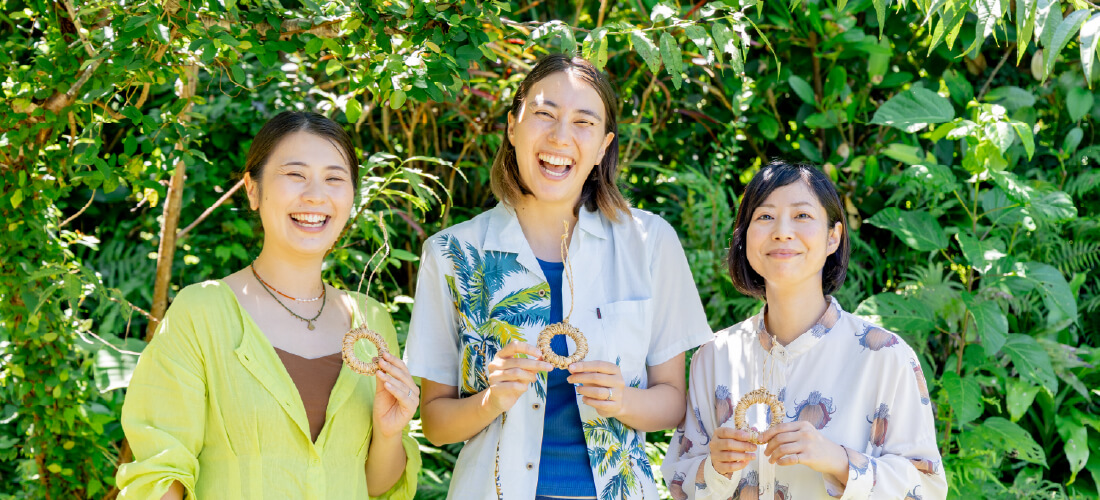
Through encounters with local storytellers, a yuta (spiritual guide), and anma—the mothers who sustain community life — you will experience the wisdom Okinawan women have inherited for generations: their way of praying, living, and nourishing themselves.

From sacred groves embraced by the forest, to night walks beneath the moonlit canopy, to meals enriched with wild herbs and seasonal plants — each moment gently reminds you of the deep connection between people and nature.

The journey concludes with crafting traditional tools using materials from Yambaru, inviting you to quietly remember what it means to live in harmony with the natural world.

It may seem like a trip outward, but in truth, it is a journey that softly brings you back to your inner self. Together with Okinawa’s nature and its people, Women’s Journeys becomes a “quiet story of renewal”—a return to who you truly are.

Example

●DAY1

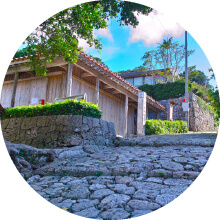
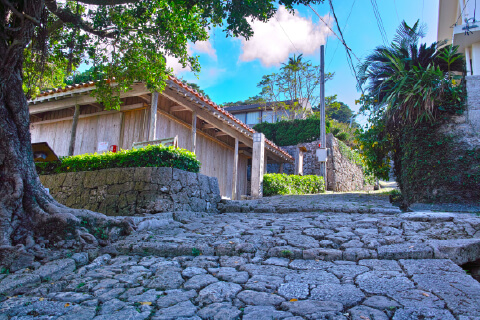
Your journey begins by touching the history, culture, and daily life that shape Okinawa. In the morning, you’ll stroll through Shuri, where the memory of the Ryukyu Kingdom still lives. Passing through its vermilion gates and following the old stone paths, your perspective gently shifts — from “a place to visit” to “a place where people live.”

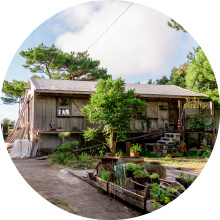
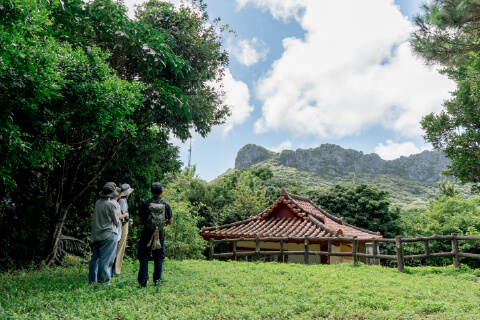
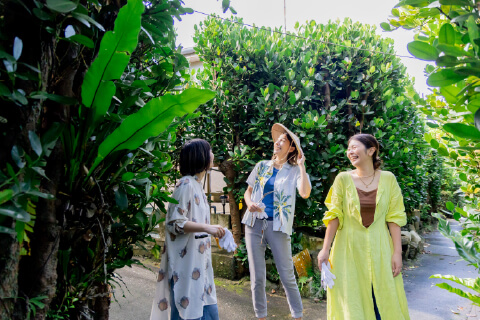
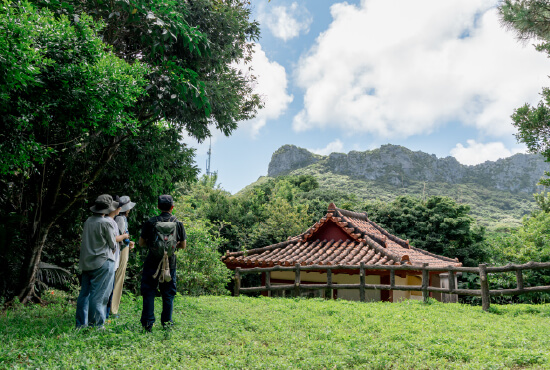
A guided walk through a living Yambaru community, shaped by generations of everyday life. Along unpaved paths and beneath rows of Fukugi trees, participants move at a relaxed pace, noticing how homes, roads, wind, and light reflect ways of living with nature. Encounters with daily life may happen naturally, but the focus remains on sharing time and space—feeling the rhythm of the community rather than observing it from outside.

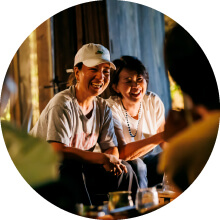
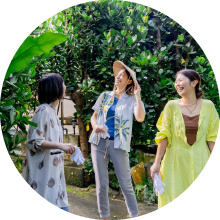
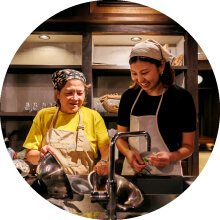
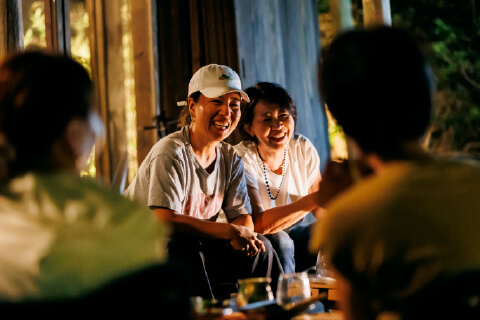
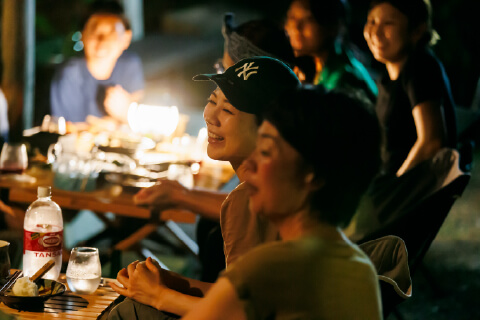
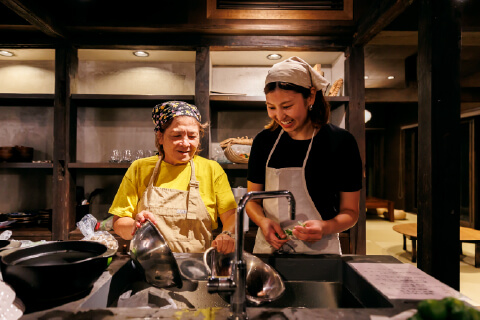
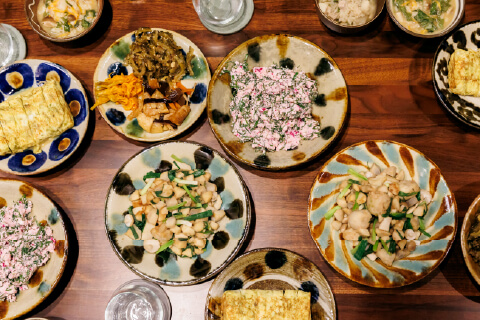
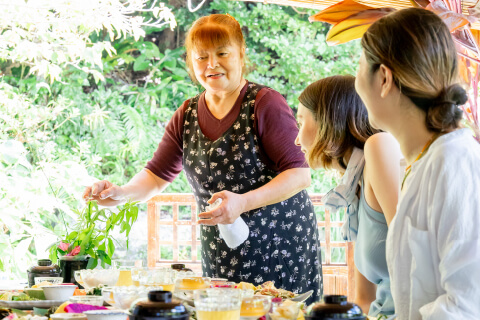
As evening arrives, you join a local anmā (mother) to prepare Okinawan home-style dishes. Around the fire, laughter and conversation flow, along with lessons on longevity such as “eating in moderation” and enjoying awamori mindfully. The warmth at the table nurtures a gentle sense of connection with your fellow travelers.

●DAY2

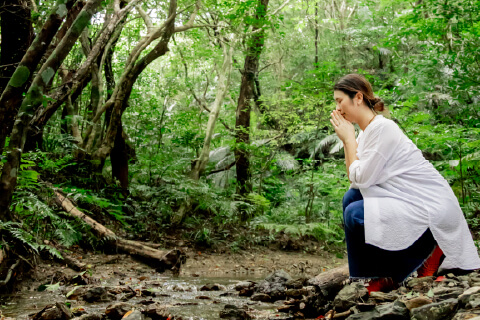
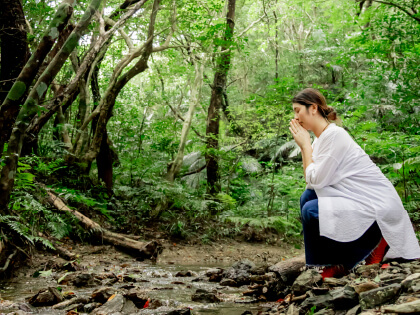
This half-day walk explores an ancient Yambaru community shaped by prayer and daily life. Guided through paths surrounded by forest, water, and sacred sites, guests spend time with a person who has long been engaged in prayer practices and spiritual traditions. Rather than rituals or explanations, the experience centers on quiet presence—sensing how land, memory, and unseen dimensions gently intertwine.

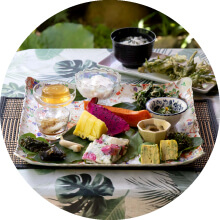
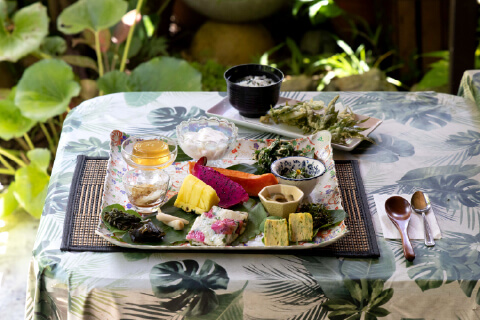
A quiet lunch experience shaped by Yambaru’s land and seasons. Once a reservation is made, wild herbs and locally rooted ingredients are gathered from the surrounding environment and prepared without a fixed menu. Cooked by a local woman deeply familiar with this land, the meal unfolds through gentle conversation, inviting guests to sense how nature and human hands come together at the table.

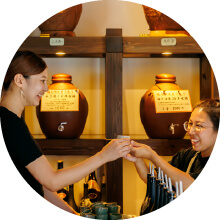
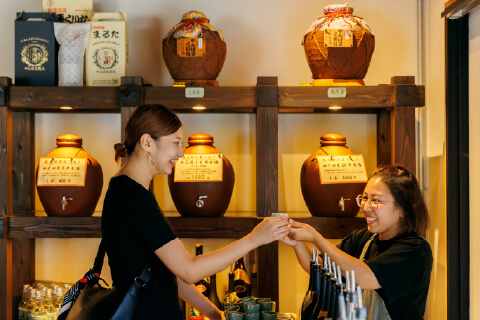
In the afternoon, you visit Yambaru Distillery, born from local investment and community spirit. Here you learn about the owner’s journey of raising a family while running the distillery, and her hope to carry awamori forward—not only as a drink, but as a way of connecting people. Awamori here is not merely alcohol; it is a living story inherited by the community.

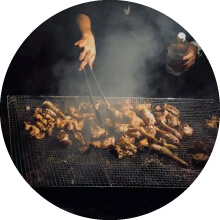
The day ends with a BBQ featuring Yambaru ingredients, where the aroma of charcoal and soft laughter blend into the night air.

●DAY3

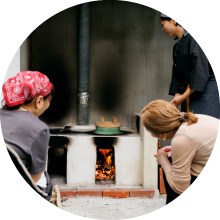
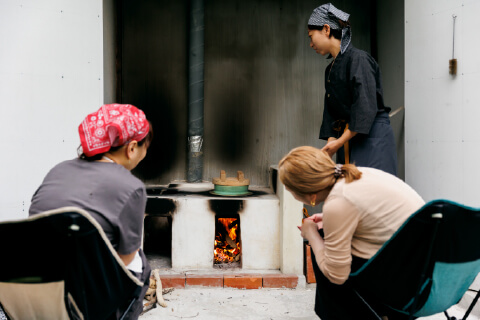
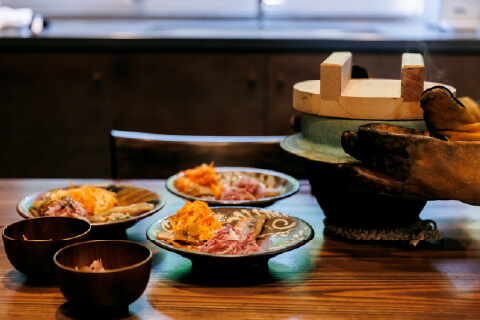
Your morning begins with cooking rice in a traditional kamado hearth. Surrounded by the sound of crackling fire and rising steam, you rediscover the richness of time and care in preparing a meal.

A hands-on workshop using natural materials traditionally found in Okinawan daily life. Participants begin by touching and preparing plants such as adan or shell ginger, then slowly move into crafting simple traditional items with guidance from a local artisan. Rather than focusing on technique alone, the experience emphasizes the rhythm of working with nature—splitting, weaving, shaping—allowing the wisdom of everyday island life to emerge through the hands.

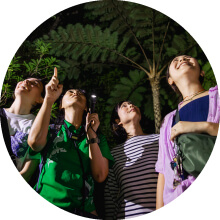
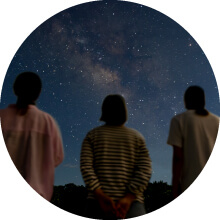
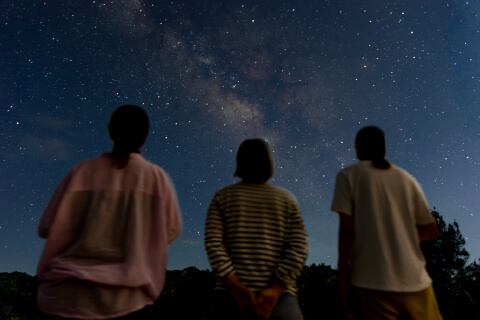
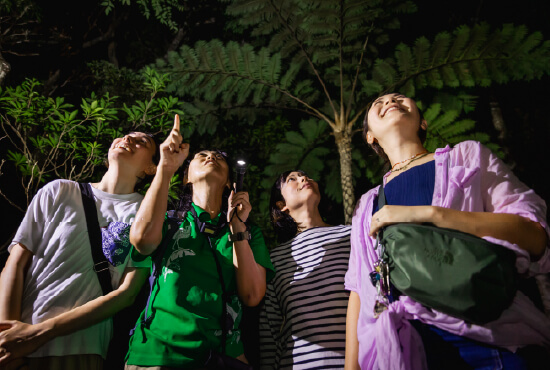
An evening experience that begins with a slow walk through the forest alongside a nature guide, followed by still time beneath the night sky. As the group moves quietly through the darkened forest, attention shifts toward sound, air, and subtle movement. Later, participants remain in one place—sitting or lying comfortably—allowing starlight, darkness, and silence to settle in. Without commentary or explanation, the night naturally opens the senses.

●DAY4

The landscapes, words, and human warmth encountered over four days settle quietly within you. Though the journey moves outward into the world, it gently leads you inward, toward yourself. The soft awakening in your heart casts a warm glow over the journey’s final moments.

Accommodation

We offer accommodation options tailored to your preferences.
Here are some examples of the unique properties we partner with:

◆Yambaru Hotel Nanmei Shinshitsu
Stay within a community that has endured for over 400 years, where you gently slip into the rhythms, traditions, and quiet beauty of a way of life passed down through generations.

◆BUNAGAYA
Created within a former school with 127 years of history, this unique stay is inspired by the theme of “fable.” It offers a space where the mind can freely wander between what is real and what is imagined—a place with room for stories, contemplation, and play.


【Precautions】

●If you have any allergies or dietary restrictions, please inform us at the time of booking.
●The itinerary may be subject to change depending on operational circumstances.
●Please note that the schedule may change or the tour may be canceled due to seasonal or weather conditions.
●If you feel unwell during the tour, please notify a staff member immediately.
Recommended tours
available in this category

The background
to this tour

Women’s Journeys was born from encounters with the women of Yambaru.
Women who support one another within their communities, live in harmony with nature, and honor themselves as they move through life. Witnessing their way of being gave me courage and invited me to reflect on what it truly means to “live as myself.”

Rooted in this personal experience, Women’s Journeys invites each participant to become the protagonist of her own story. Through encounters with nature, culture, and the women of the region, the journey encourages a gentle return to the self. What we provide is simply a stage and the moments that spark reflection. In the quiet of the forest or beneath the night sky, or in heartfelt conversations with local women, participants listen to their inner voice and reconnect with their own sensibilities. The small realizations that arise in those moments remain as a quiet source of strength, even after returning to everyday life.

Throughout the journey, participants and local women resonate with one another, creating a cycle of empathy and empowerment. These waves extend beyond the individual — reaching families, communities, and contributing, little by little, to a society where women can live in alignment with who they truly are.

Women’s Journeys is a travel experience that gently accompanies your life, a journey that helps you remember the light that guides you forward when you feel lost — a story of reconnection, renewal, and the deep bonds that arise when we return to ourselves.

<Recommended tours available in this category>

Yambaru Forest
Night Nature Walk & Star Bathing

A Night Immersed in Forest and Stars

Tour Overview

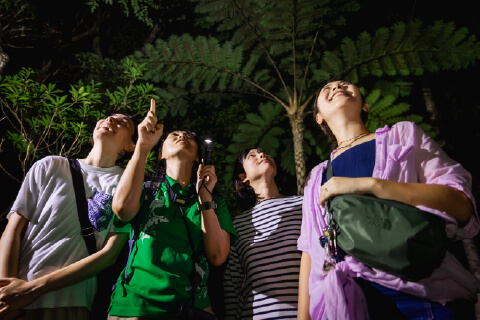
This experience combines a slow night nature walk through the forests of the Yambaru region with a quiet period of Star Bathing beneath the night sky, inviting participants to deeply immerse themselves in the atmosphere of the night.

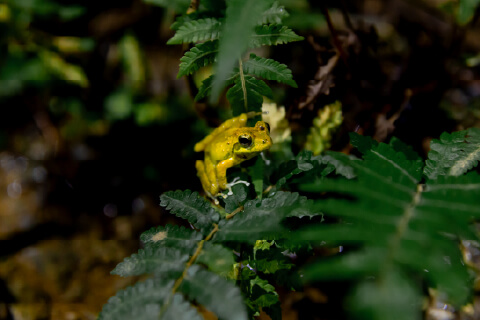
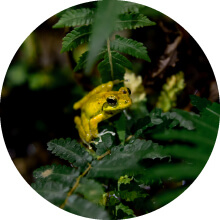
During the Night Nature Walk, guests enter the forest alongside a local nature guide and move at a gentle pace, attuning their senses to sounds, subtle movements, and the heightened awareness that emerges after dark. Encounters with nocturnal creatures and the forest’s nighttime expressions may occur, offering a chance to experience the forest through all five senses rather than through explanation alone.

Star Bathing takes place in a calm, natural setting—surrounded by forest or in a quietly open area beneath the sky. Without significant movement, participants remain in one place, resting under the stars and allowing themselves to be enveloped by starlight, deep darkness, night air, and silence. No astronomical explanations are provided; the focus is on the simple experience of being present beneath the night sky.

Conducted in small groups, this program weaves together moments of movement and stillness, forest and sky. By experiencing these contrasting aspects of the night in sequence, participants are gently guided through a process in which their senses gradually open. The experience offers a quiet step away from daily life and an opportunity to reconnect with one’s own perceptions through direct contact with the natural rhythms of the night.

Specific locations and routes are not disclosed in advance in order to protect the natural environment and preserve the quality of the experience.

Tour Story

When you place yourself in the natural landscapes of Yambaru at night, a world entirely different from daytime begins to emerge — quietly, almost unnoticed.

As you step into the forest, visibility narrows and light softens. In its place, sounds, subtle movements, and the weight of the air become more pronounced. Insect calls, the rustle of leaves, the quiet presence of unseen life. The night forest reveals itself not first through sight, but through sound, atmosphere, and sensation — felt in the body before it is understood by the eyes.

With vision limited, other senses gently open. Ears, skin, and breath become more attentive, allowing a distinctly nocturnal world to rise into awareness.

During the Night Nature Walk, participants move slowly through the forest, opening their senses to the profound contrasts between day and night. Listening closely to sounds that stand out in the darkness, they may encounter nocturnal creatures and a different expression of the forest — one that remains hidden during daylight hours.

Beyond the walk, a quiet moment awaits beneath the open night sky. With lights lowered and eyes turned upward, participants spend time in Star Bathing — resting beneath the sky, surrounded by darkness and night air. Here, the focus is not on understanding stars or celestial bodies, but on the simple experience of being present beneath the night sky.

There is no expectation to speak. Some may share words as they arise, others may remain in silence, gazing into the darkness alongside the stars. Both are natural, each becoming part of the gentle rhythm that flows through the night.

Through the contrast of movement in the forest and stillness beneath the stars, senses gradually soften and release. Sounds and presences once overlooked in daily life begin to surface naturally.
This experience offers no clear answers or conclusions. Yet the memory of being held by the night — by forest and sky — may later return as a quiet afterglow, rising gently when least expected.

Wrapped in the night forest and the open sky, participants are invited to step back into the natural rhythm of the world — and into their own senses — sharing a quiet night shaped by presence rather than purpose.

Experience Flow

●Arrival & Orientation

Guests meet with the nature guide at the designated meeting point. A brief orientation is provided, outlining the overall flow of the experience, safety considerations, and basic guidelines for spending time in the natural environment at night.
Participants receive simple instructions on the use of lights and nighttime movement, allowing their attention to gradually shift from daytime awareness to the rhythms of the night.

●Night Nature Walk – Entering the Forest

Accompanied by the nature guide, the group enters the forest and begins a slow, gentle walk. The route is relatively easy, with minimal elevation change, allowing participants to move comfortably at a relaxed pace.
As the walk progresses, attention is directed toward the sounds, movements, and subtle environmental changes that emerge after dark. Guests may encounter nocturnal insects, animals, or other signs of nighttime life. When appropriate, the guide offers brief explanations, keeping the focus on observation and sensory awareness rather than detailed interpretation. Pauses may be taken along the way to stand still, reduce light, and experience the forest’s darkness and quiet more fully.
●Star Bathing – Remaining Beneath the Night Sky

At a suitable natural setting — surrounded by forest or in a quietly open area — the group remains in one place to transition into a period of Star Bathing. Participants are invited to lie down, sit, or stand in whatever posture feels most comfortable, allowing themselves to be held by starlight, darkness, night air, and silence.No astronomical explanations are provided. The emphasis is on being present beneath the night sky rather than observing or learning about it. This portion of the experience encourages stillness, reflection, and quiet awareness, allowing the sensations of the night to settle naturally.

●Closing the Experience

The experience concludes quietly, preserving the atmosphere and afterglow of the night.Participants depart at an unhurried pace, carrying with them the impressions and sensations gathered throughout the evening.

Please note: Depending on weather and on-site conditions, the order or content of the experience may be adjusted.

<Recommended tours available in this category>

An Ancient Community
Where Myths Still Live

Tracing Ryukyuan Creation Stories and Living Prayer

Tour Overview

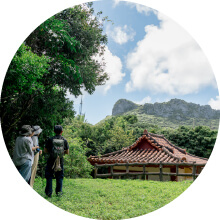
This half-day experience (approximately 3–4 hours) invites guests to visit an ancient community in the Yambaru region of northern Okinawa, where daily life and prayer have quietly coexisted for generations.

The area is known as a place where fresh water was once collected for rituals of the Ryukyu Kingdom, and where royal prayers and local spiritual practices continue to resonate gently within the landscape. Surrounded by forest, water, and sacred prayer sites (utaki), the community is explored slowly on foot, allowing time to engage with the environment itself.

During the tour, guests spend time with a person who has long been involved in prayer and spiritual traditions. Rather than performing specific rituals or teaching a belief system, the experience centers on being present in the place—listening closely to the atmosphere, the land, and the subtle qualities that emerge when one slows down. Attention is gently guided toward nature and the unseen dimensions of the site, while each participant engages with the experience in their own way.

The tour is conducted in a small group and proceeds at a relaxed pace, emphasizing walking and quiet observation. This format is well suited for guests with a strong interest in culture, spirituality, and reflective travel, offering a deeply immersive yet understated encounter.

Rather than visiting landmarks as a form of sightseeing, this experience invites guests to step into a landscape shaped by prayer and memory, receiving Okinawa’s spiritual culture not through explanation, but through direct presence and sensation.

To protect the local community and preserve the quality of the experience, specific place names and detailed itineraries are not disclosed in advance.

Tour Story

Scattered across the northern reaches of Yambaru are old communities where prayer and everyday life have long been interwoven. The memories held here are not preserved in written records or timelines, but quietly embedded in the land itself — in the flow of water, the placement of stones, the contours of the forest, and the paths shaped by wind and time.

This tour approaches such places not as sites to be studied, but as spaces to be entered and encountered. Rather than seeking explanations or conclusions, participants are invited to simply be present—to stand, to walk, and to listen to what the land expresses without words.

As the journey unfolds, attention naturally shifts away from interpretation and toward sensation: the sound of leaves moving in the forest, the weight of the ground beneath one’s feet, the subtle stillness that gathers around places of prayer. In this quiet, the accumulated time of the land begins to reveal itself—not as information, but as atmosphere.

Throughout the experience, time is shared with a practitioner who has long engaged with prayer and spiritual traditions across different regions. This presence is not that of a historical guide, but of someone who faces places of prayer directly and listens attentively to what arises there. Through posture, silence, and carefully chosen words, participants may encounter new perspectives on the relationship between nature, people, and unseen dimensions of the world.

At moments, messages or impressions received in relation to the prayer sites may be shared. How these are received or understood is left entirely to each participant; there is no single meaning, interpretation, or expectation.

This experience does not aim to provide answers, teachings, or beliefs. There is no requirement to understand, articulate, or define what is felt.

Instead, time spent within these landscapes may linger quietly after returning to daily life — surfacing unexpectedly, not as something learned, but as something once touched.

What remains is not knowledge of Okinawan spiritual culture, but the memory of having briefly stood within it.

Experience Flow

●Arrival & Introduction

Guests meet with the guide and a practitioner who has long been engaged with prayer and spiritual traditions at the designated meeting point. A brief overview of the tour flow and safety considerations is provided, along with contextual guidance on the historical background of the area and an appropriate mindset for visiting places of prayer.

●Walking Through the Community & Time with the Spiritual Practitioner

The group walks slowly through the community, surrounded by sacred prayer sites, forest, and water. The experience emphasizes moving on foot at a relaxed pace, allowing guests to sense the atmosphere and natural environment of the land.
Rather than relying solely on verbal explanation, time is spent simply being present—standing, walking, or quietly observing—while attention is gently directed toward nature and the unseen presence of the place. Participants are free to engage in ways that feel natural to them, whether through listening, speaking, or remaining silent.
At times, insights or impressions received by the spiritual practitioner while engaging with the prayer sites may be shared with participants, depending on the moment and context.

●Quiet Time Within the Community

At selected locations such as utaki or surrounding natural spaces, the group pauses to allow participants to reflect on their individual experiences. Simple prompts or words may be offered when appropriate, but there is no requirement to articulate or explain one’s experience.

●Closing of the Experience

The tour concludes quietly, allowing participants to carry their impressions and reflections with them as they depart. Rather than a formal ending, the experience fades naturally, leaving space for personal interpretation and afterthought.

<Recommended tours available in this category>

Gathered Around the Fire

An Island Fire BBQ of Shared Bounty

Tour Overview

This BBQ experience invites you to slow down and share time around the fire, immersed in nature.

The setting is carefully selected according to the day’s natural conditions and the group, such as an outdoor space near the forest or the sea. Participants engage directly with the fire, listening to the crackle of burning wood, watching smoke rise, and observing the subtle changes of the flames as they create the meal together.

This program values the entire process — lighting the fire, tending it, cooking, waiting, and finally tasting. Rather than rushing toward results, participants are invited to follow the pace of the fire, allowing the sense of time and the distance between people to gently soften.

Using locally sourced ingredients, prepared with minimal intervention, the focus is on drawing out the natural flavors of each element. By gathering around the table in nature, eating becomes less about consumption and more about sharing.

The experience is conducted in small groups, where participants are free to enjoy conversation or simply sit quietly by the fire. Each person can find their own comfortable rhythm and distance within the space.

By facing the fire together in a natural setting, relationships—between people and with the place itself — begin to slowly unfold. This BBQ program offers time not to rush, but to be present, together.

Specific locations are not disclosed in advance in order to protect the natural environment and preserve the quality of the experience.

Tour Story

When we sit before a fire,time naturally begins to slow.

The crackle of burning wood, the smoke rising softly into the air, the subtle shifts in the color of the flames. Fire does not hurry us, nor does it give instructions — it simply exists, steadily, in front of us.

This BBQ experience is not only about eating. It is an invitation to face the fire, and to savor time itself.

Participants light the fire, tend it, and bring it into balance, listening to the sounds and breathing in the aromas as ingredients slowly cook. Rather than seeking quick results, they follow the rhythm of the fire, allowing breath and conversation to soften naturally.

Around the fire, words may arise on their own, or there may be moments of quiet, spent simply watching the flames and sharing the same time in silence.

Both are welcome here. Speaking or not speaking — either feels natural in this space.

Local ingredients are prepared with minimal intervention, trusting the strength and character of the ingredients themselves. By gathering around the table in nature, eating shifts from an act of consumption to one of sharing.

Fire creates a gentle distance and warmth between people — a balance that feels just right.

There are no lessons to master and no conclusions to reach. Yet the memory of time spent with fire and food may later resurface, quietly and warmly, in an unexpected moment.

Surrounded by nature, gathered around the fire, sharing food and time together — this is a BBQ experience meant to be shared softly and unhurriedly.

Experience Flow

●Gathering & Orientation

Participants meet the guide or staff at the designated meeting point. Based on the day’s setting and natural conditions, a brief orientation is given, covering the overall flow of the experience and essential safety guidelines.
Basic rules for working with fire and considerations for spending time in a natural environment are shared, allowing participants to gently shift their mindset and settle into the time ahead.

●Preparing the Fire

The experience begins with participants engaging directly with the fire — lighting it, tending it, and gradually bringing it into balance.
As they listen to the crackle of the wood, watch the smoke rise, and observe the subtle changes in the flames, preparations unfold without haste, following the pace of the fire itself.
This time serves as a process of returning the body and senses to a more natural rhythm.

●Grilling, Waiting, Tasting

Once the fire is ready, ingredients—primarily locally sourced — are grilled simply, while carefully observing the condition of the fire.
Participants move slowly through the cycle of grilling, waiting, and tasting, noticing the sounds, aromas, and the delicate balance between fire and food.
Some may enjoy conversation, while others may choose to focus quietly on the fire or the ingredients. Each person is free to engage in the way that feels most natural to them.

●Sharing the Table

As dishes are ready, participants gather around the table and share the meal in the surrounding natural environment.
There is no fixed structure or expectation for conversation. Participants may focus on eating, or simply sit back and watch the fire as time passes.
Within the gentle atmosphere created by the fire, a comfortable sense of distance and connection naturally emerges.

●Closing & Departure

As the time with food and fire comes to an end, the experience is brought to a quiet close, allowing the atmosphere to linger.
Participants watch as the fire gradually settles, and depart carrying the memory of the shared time with them.

Please note: Depending on weather conditions and circumstances on the day, the content or sequence of the experience may be subject to change.

<Recommended tours available in this category>

Haikei BBQ

A Fire-Centered Culinary Heritage Experience of Yambaru

Tour Overview

This BBQ experience centers on Haikei, a traditional soul food of Yambaru, particularly the Kunigami area, and offers an intimate encounter with fire, food, and the wisdom of local everyday life.

Haikei refers to chickens that have finished laying eggs and are prepared with gratitude rather than waste—an ingredient that symbolizes Yambaru’s food culture and values. In this program, Haikei is grilled over charcoal by a certified Haikei Meister, officially recognized by the Haikei Meister Association.

By carefully judging the heat and timing for each cut, the Haikei Meister adjusts the grilling process to suit participants’ preferences.The result is a depth of flavor and texture unlike that of a typical BBQ. Guests are invited not only to taste the finished dish, but also to share the time in which food is created—standing close to the fire, observing the process, and engaging with the rhythm of cooking itself.

The venue is selected according to the day’s natural conditions and group composition, such as forested areas or spaces near local communities. Gathered around the fire, a gentle sense of connection emerges, and eating shifts from an act of consumption to one of sharing.

Conducted in small groups, this experience offers a quiet approach to the heart of Yambaru’s food culture, through techniques and ways of living that have been passed down within the community.

Specific locations are not disclosed in advance in order to protect the natural environment and preserve the quality of the experience.

Tour Story

This BBQ experience centers on Haikei, a soul food passed down in Kunigami Village, Yambaru — an expression of fire, food, and local wisdom shaped by everyday life.

Haikei refers to hens that have finished laying eggs. Rather than being wasted, they have long been received with gratitude — a reflection of Yambaru’s way of honoring life through use, care, and respect.

In earlier times, meat was a precious treat in this region. Hens that had finished their role as egg layers were also an important source of protein. While Haikei is often used for stock or minced meat elsewhere, in Yambaru—particularly in Kunigami—it has traditionally been grilled whole over charcoal, allowing the meat itself to be fully enjoyed.

If grilled like young chicken, Haikei can become tough and difficult to eat. But in the hands of someone who truly understands it, the same bird transforms into a dish that is surprisingly juicy and rich in flavor.

In this experience, Haikei is grilled by a Haikei Meister — a formally certified member of the Haikei Meister Association, a group founded by local volunteers to preserve this rare culinary craft. It is said that fewer than ten Haikei Meisters exist worldwide today.

Each cut requires different heat, timing, and attention. Guests are invited to share their preferences while watching the Meister’s skilled hands at work, experiencing the subtle changes in texture, fat, and aroma as the meat is prepared.

In Yambaru, there is an old saying: “A man who can grill Haikei well is popular.” Perhaps this was not only about skill with fire, but about understanding the ingredient—and the spirit of sharing that comes with it.

The setting is chosen based on the day’s natural conditions and group composition — often near forests or local communities. As people gather around the fire, a gentle sense of distance and warmth naturally emerges, and eating shifts from an act of consumption to one of sharing.

Sitting together around the charcoal fire, enjoying freshly grilled Haikei, this is not simply a BBQ. It is a moment to touch the pride, everyday life, and inherited skills of Yambaru — passed quietly from one generation to the next.

Facing the fire, receiving life with gratitude. Haikei BBQ is a time to gently step closer to the heart of Yambaru’s food culture.

Experience Flow

●Arrival & Orientation

Guests meet at the designated meeting point with the guide or staff, along with the Haikei Meister. Depending on the day’s environment, a brief orientation is provided, outlining the overall flow of the experience, safety considerations, and basic guidelines for working with fire. Participants are invited to shift their mindset—preparing to spend time with fire, food, and the natural surroundings in a calm and attentive way.

●Preparing the Fire

Guests gather around the fire as the Haikei Meister carefully prepares and adjusts the charcoal. The crackling of wood and charcoal, rising smoke, and subtle changes in heat and flame gradually set the pace. Rather than rushing, preparation follows the rhythm of the fire itself. This time serves as a gentle transition—allowing participants to step away from the pace of everyday life and settle into a different sense of time.

●Grilling & Savoring Haikei

As the fire reaches the right condition, the Haikei Meister begins grilling the Haikei, adjusting the heat and timing for each cut. Preferences for doneness and texture are taken into account, and each bird is finished carefully, one by one. Guests share the moment as sound, aroma, and movement around the fire transform the ingredients into a meal—witnessing how fire and food come together through skilled hands.

●Sharing the Meal

Once prepared, the Haikei is shared at the table in the natural setting. There is no fixed structure or expectation for conversation. Guests may focus on eating, talk freely, or simply sit quietly, watching the fire. Within the gentle atmosphere created by gathering around the flames, a natural sense of connection and ease begins to emerge.

●Closing the Experience

As the meal and time by the fire come to an end, the experience concludes quietly, leaving space for reflection. Guests watch as the fire gradually settles, then depart carrying their own impressions of the time spent together.

Please note: Depending on natural conditions and circumstances on the day, the flow or order of the experience may be adjusted.

<Recommended tours available in this category>

A Morning in Yambaru,
Awakened by Fire

Breakfast Cooked Over a Traditional Kamado Hearth

Tour Overview

Morning arrives quietly at a private villa embraced by the forests of Yambaru. This experience begins not with a schedule, but with lighting a fire.

Wood is placed into a traditional kamado stove, and as the flames catch, you listen to the sound of fire and watch its gentle movement while rice is slowly cooked.

The heat is adjusted not by numbers, but by sight, sound, and the feel of your hands. It is a morning guided by the senses — different from convenience, and rooted in bodily awareness.

Alongside the rice, breakfast is prepared using local ingredients prepped by community mothers. Seasonal vegetables and the gifts of the land are served not with bold seasoning, but as an extension of everyday life in Yambaru.

This is not an experience designed to teach cooking. Its heart lies in standing beside one another, watching the fire, sharing the same aromas, and spending the same unhurried time together.

The steam rising from freshly cooked rice, the warmth of the kamado, and the stillness of the morning air.

As you attune yourself to the rhythm of life in Yambaru, this breakfast gently aligns both body and mind, setting the tone for the day ahead.

Tour Story

In the early morning, while the forest air still holds a gentle coolness, only birdsong and the distant rustle of leaves surround the lodge.

This morning begins not with an alarm, but with the quiet presence of fire — slowly, naturally coming to life.

Logs are placed, flames rise, and there is time to wait as the fire settles within the kamado.

The color of the fire, its sound, its warmth — you watch with your eyes, listen with your ears, and sense it through your hands as the rice begins to cook.

Stepping just slightly away from convenience, you gently turn your attention back to the body. That alone is enough to feel dormant senses gradually awaken.

Alongside the rice are simple dishes prepared in advance by local mothers, made with ingredients from Yambaru. They are not special recipes, but an extension of the breakfast tables that have long been part of everyday life here.

Someone tends the fire. Someone arranges the dishes. Even without words, there is a shared sense of spending the same morning together.

Steam rises from the freshly cooked rice, and the warmth of the kamado quietly reaches deep into the body.

This breakfast is not a time to learn something new. It is a time to gently align the beginning of the day — with nature, with others, and with yourself.

A morning welcomed by fire leaves behind a deeper, calmer feeling, a quiet return to your inner self.

Entrusting yourself to the rhythm of life in Yambaru, this place’s unique morning softly opens into today.

Experience Flow

●A Quiet Beginning

The experience begins quietly in the early morning, while the forest air still carries a gentle coolness.
Surrounded by birdsong and the soft rustling of leaves, you naturally ease into the rhythm of the morning in this place.
There is no formal orientation or instruction. Rather than “starting” something, it feels as though you are simply joining the flow of the morning as it unfolds.

●Lighting the Fire

Fire is kindled in a traditional kamado hearth, placing firewood carefully and waiting as the flames slowly take hold.
Watching the fire stabilize is a quiet, attentive moment. The color of the flames, their sound, the warmth they give off — you engage with the fire through sight, hearing, and touch. It is a time to be present with the fire itself.

●Cooking Rice in the Kamado

Once the fire settles, rice is set to cook in the kamado. There are no numbers, timers, or fixed rules. The heat is adjusted by sensing the flames and the rising steam, responding to the fire rather than controlling it.
Stepping slightly away from convenience, you turn your attention toward bodily awareness and intuition.

●Preparing the Morning Meal

While the rice cooks, side dishes prepared in advance by local mothers using ingredients from Yambaru are quietly brought out.
These are not elaborate dishes, but foods that reflect everyday meals long prepared in this land — an extension of the local morning table.

●Sharing Breakfast

Steam rises from the freshly cooked rice, and the warmth of the kamado gently reaches deep into the body.
Someone watches the fire, someone arranges the bowls and dishes. Even without words, there is a shared sense of being present in the same morning together. Breakfast is enjoyed slowly, each person at their own pace.

●Carrying the Morning into the Day

After the meal, the lingering warmth of the fire, the memory of steam, and the quiet of the morning remain within you.
Without a clear ending, each person naturally returns to their day.
This experience is not about learning a skill. It is a way of gently tuning the beginning of the day — together with nature, and together with others.

<Recommended tours available in this category>

Wandering Through
a Yambaru Community

Where Wind and Everyday Life Meet

Tour Overview

In communities nestled between the forests and the sea of Yambaru, everyday life continues quietly — unchanged by the framing of tourism.

This walking tour is not about visiting landmarks. Instead, you move slowly along the community paths, taking time to walk, pause, and be present.

Along these paths, fukugi trees have taken root over generations, standing as living windbreaks against storms and typhoons, growing alongside human life over long stretches of time. The placement of homes, the gentle curves of the roads, and the ways the wind moves through the community all quietly speak of how life has been shaped here.

Everything you encounter reflects the wisdom of people who have lived in harmony with nature, and the rhythms of daily life formed patiently over time.

As you walk, you may pass someone tending a small field, someone resting at the edge of their home, or the subtle presence of ordinary moments.

There is no staging, and this is not an experience designed to “show” community life. You simply place yourself within the space, and begin to sense the atmosphere of a way of living that continues today.

In Yambaru communities, nature, prayer, and daily life have never been separate. To walk these paths is to gently step into that overlapping world.

The texture of the earth beneath your feet, the sounds that drift through the air, the touch of wind and light on your skin.

This is a time to walk not by looking, but by feeling — an experience shaped through all five senses.

This tour is not meant for learning facts. It is about walking quietly as part of the community, pausing when needed, and matching your breath to the rhythm of the place.

Through this shared time, the contours of what it means to live on this land begin to emerge naturally — not through explanation, but as a felt experience.

Tour Story

As you take your first steps, the gentle texture of the path—unpolished and uneven — slowly makes itself felt beneath your feet.

Birdsong, the soft rustle of leaves, the faint scent of everyday life drifting from nearby homes.

Here, rather than seeing something, it may feel closer to quietly passing through a life that is already there.

Along the path stand fukugi trees, their roots spread wide as if protecting daily life from wind and typhoons. Growing taller than a person, they have watched over this place and its people for a very long time.

The road does not run straight. It curves gently, and the view never opens all at once.

It is a form shaped gradually, through a sensitivity to the connection between people and presences that cannot be seen.

As you walk, you may catch the eye of someone working in a field, or sense a quiet pause at the edge of a veranda.

Sometimes greetings are exchanged. Sometimes they are not. Both feel natural within this community.

There is no special explanation. And yet, in the placement of homes, the curves of the road, the way the wind passes through, the traces of countless choices made over time quietly begin to emerge.

As your pace slows, the feel of the earth beneath your feet, the breeze against your skin, the sounds around you gradually become more vivid.

Here, nature, prayer, and daily life are not spoken of as separate things. They overlap, existing together in the same space, as a matter of course.

To walk through the paths of the community is to place yourself, for a while, within that overlap.

Without trying to understand, without being given explanations, the contours of what it means to live here remain quietly within you, settling somewhere inside.

When the walk comes to an end, there may be no strong sense of achievement. But you might notice that your breath has deepened slightly, that your way of seeing has shifted—just a little.

That is the quiet aftertaste of time spent walking through a Yambaru community.

Experience Flow

●A Quiet Beginning

The path ahead is not one created for visitors, but a road shaped by everyday life over generations.
Participants naturally begin to notice the feeling beneath their feet, the air around them, and the rhythm of the morning as they start to walk.

●Following the Community Paths

Unpaved roads, gently curving lanes, rows of Fukugi trees standing as windbreaks.
The shape of the paths, the placement of homes, the way light and wind move through the community reflect choices made over a long period of time — ways of living in close relationship with nature.
The guide offers quiet context only when needed, adding gentle words that help connect the landscape with daily life.

●Encountering Everyday Life

Along the way, you may pass someone working in their field, someone resting at the edge of their home, or subtle signs of daily routines continuing around you.
Sometimes greetings are exchanged. Sometimes there are no words at all.
Both are natural here. Rather than observing from outside, you simply share the same space and time.

●Pausing to Feel

At certain points, the group may pause — where the wind flows differently, or where the path bends and narrows.
The texture of the ground, the breeze on your skin, the layers of sound become more noticeable.
Through your senses, you begin to feel the rhythm of the place in your own way.

●Ending with a Sense of Aftertaste

At the end of the walk, there is no formal conclusion or reflection. The experience fades naturally, leaving behind subtle impressions — a deeper breath, a quieter mind, a slight shift in how you see your surroundings.
This walk is not about learning facts. It is about sharing time within a living community, moving at its pace, and quietly aligning with its rhythm.
What remains afterward is not something you are told, but something you carry with you.

<Recommended tours available in this category>

Time Spent at Agachi Mui

A Moment of Breathing with Nature

Tour Overview

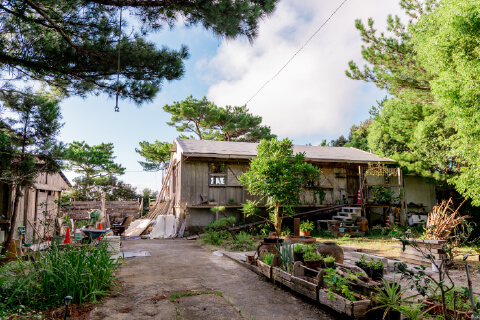
At the edge of the forest, quietly nestled among the trees, stands a small café called Agachi Mui. Without venturing deep into the mountains, the moment you step inside, you are gently wrapped in the presence of Yambaru’s forest.

The café is run by a couple who built everything with their own hands — from the foundation and structure to the interior and furniture. Within this warm, wooden space, the feeling of living within nature exists naturally, without force or ornament.

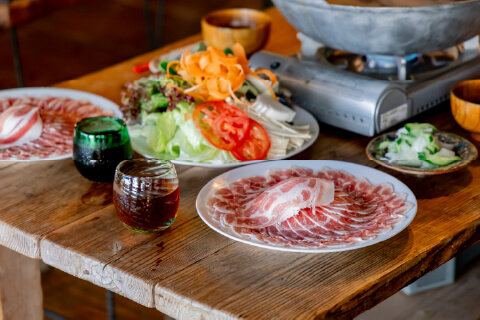
At the heart of the cuisine are local ingredients, prepared with care and consideration for the body. Among them, one dish stands out as a reflection of the region’s unique food culture: inobuta shabu-shabu.

Inobuta, a cross between wild boar and pig, carries the deep, robust flavor of boar and the tenderness and sweetness of pork. It is a form of food nurtured through Yambaru’s nature and everyday life. Because inobuta reproduce infrequently and require long periods of careful rearing, only a very small number are raised in Yambaru today.

The lean meat is rich and full-bodied, while the fat is gently sweet, melting on the tongue without heaviness. With each bite, a quiet awareness spreads — the feeling of truly receiving life.

As evening approaches, the wooden deck opens to a sunset where forest and sea meet in the distance. When night falls, insects, birds, and occasionally rare creatures emerge softly from the forest, drawn toward the light and warmth.

Agachi Mui is not a place created solely for visitors. It is a space of rest for local people, woven into their everyday lives — an extension of living alongside nature and receiving its gifts with gratitude.

The name *Agachi Mui* comes from “agachi,” an old local name for the Okinawa rail, and “mui,” meaning forest. It is a forest where the Okinawa rail lives, and a place that gently reminds us that humans, too, are part of nature.

Time spent here is not simply about having a meal. It is a moment that quietly settles within the body and the heart — a gentle reminder of the essential connection that human life exists because nature does.

Tour Story

Following the road that leads toward the forest, the view gently opens, and Agachi Mui appears among the trees. You haven’t ventured deep into the mountains — yet the depth of the forest is unmistakably present here.

Leaves move softly in the wind. Bird calls overlap in the distance. The earth beneath your feet quietly reminds you that you are standing within nature.

As you settle into the warm, wooden space, time begins to slow. There is no need to rush, no sense of efficiency to follow. Your body gradually aligns with the rhythm of the forest itself.

The meal arrives, prepared with ingredients nurtured by this land. Among them, inobuta shabu-shabu stands as a form of food that could only have emerged here, in Yambaru.

As the meat passes briefly through the broth and reaches your lips, a deep, powerful richness unfolds — balanced by a gentle sweetness. Beyond taste, a quiet awareness surfaces: this is life being received.

Eating here is not separate from nature. It is part of the forest’s continuous cycle — a moment where living and being nourished are inseparable.

As evening approaches, the wooden deck opens onto a view where forest and sea blend in the distance. Light softens. The wind shifts. The boundary between day and night slowly dissolves.

When night falls, insects, birds, and other forest dwellers naturally draw closer. In that moment, you realize that humans, too, are simply another presence within this shared space.

Time at Agachi Mui is not about learning facts or consuming a special experience. It is about remembering something fundamental:

Nature exists. Life emerges from it. And humans live by receiving its gifts.

Without explanation, without effort, this understanding settles quietly into the body.

When it is time to leave, the scenery itself may not seem dramatically different. Yet your breath may feel deeper, your awareness of food more attentive, your gaze toward the forest slightly changed.

That subtle shift is the lingering resonance of time spent at Agachi Mui.

Experience Flow

●Entering the Forest

You arrive at Agachi Mui, a café quietly nestled at the edge of Yambaru’s forest. Without venturing deep into the mountains, the moment you step inside, you are gently wrapped in the air of the forest.

●Settling into the Space

You step into a wooden space handcrafted by the couple who run the café. The scent of wood, the light filtering through the trees, the path of the wind — as you take it all in, your breathing naturally begins to slow.

●A Meal with Yambaru’s Ingredients

A meal centered on local island vegetables is prepared quietly. Through one of the region’s distinctive food traditions, you begin to sense—without explanation — that eating is also an act of receiving life. A moment of quiet awareness unfolds.

●Sunset Time

As evening approaches, you move out onto the wooden deck. Beyond the forest, the sun sets over the distant sea. You linger at the threshold between day and night, simply taking in the passing of time.

●The Presence of the Night Forest

As darkness falls, insects, birds, and occasionally rare creatures emerge from the forest. Maintaining the feeling of being a respectful guest, you quietly observe their presence.

●Time That Ends with a Gentle Aftertaste

There is no clear ending to this experience. With the memory of the meal and the forest carried within your body and heart, you leave the space at your own pace, allowing the quiet aftertaste to remain.

<Recommended tours available in this category>

Walking Through Yambaru at Night

Being Present in the Forest After Dark

Tour Overview

This is a slow-paced night walk through the forests of northern Okinawa, where guests step into the landscape after dark and experience the forest through heightened senses rather than explanation.

The walk takes place in the Yambaru region, a UNESCO World Natural Heritage area, known for its rich biodiversity and deeply layered forest ecosystem. At night, this familiar landscape transforms—sounds sharpen, darkness deepens, and life that remains hidden during the day begins to emerge.

Guided by a local nature guide, participants move gently through the forest, paying attention to subtle contrasts between day and night: unfamiliar calls, shifting air, and the quiet presence of nocturnal life. Rather than focusing on interpretation alone, the experience emphasizes sensing—listening closely, observing carefully, and allowing curiosity to lead the way.

With minimal elevation change and a relaxed walking rhythm, the tour is physically accessible while remaining immersive. It is designed for guests who wish to reconnect with a childlike sense of wonder, awakened through contrast, silence, and the living rhythms of the night forest.

Specific locations and routes are not disclosed in advance, in order to protect the natural environment and preserve the quality of the experience.

Tour Story

After sunset, the forest of Yambaru becomes a different world.

What is familiar during the day—trees, paths, sounds—shifts subtly but completely once darkness settles in. Light recedes, unfamiliar calls emerge, and life that remains hidden in daylight begins to move.

This night walk is not designed to explain the forest in detail, nor to guide guests toward a single interpretation. Instead, it invites participants to step into the forest after dark and experience the contrast between day and night through their own senses.

As the group moves slowly through the forest, attention naturally sharpens. The quiet weight of darkness, the sudden sound of insects or birds, the feeling of air against the skin—each moment awakens a sensitivity that many people have not felt since childhood.

Unlike stargazing experiences held in open spaces, this tour remains within the forest itself. Unlike spiritually focused cultural journeys, it does not seek to interpret the unseen world. Its focus is simpler and more immediate: allowing the night forest to reveal itself through sound, movement, and presence.

Encounters with nocturnal life may occur, but they are not the goal. What matters more is the subtle shift in awareness—how darkness invites curiosity, how silence heightens perception, and how the forest feels alive in a different rhythm after nightfall.

This experience offers no conclusions and no answers to take home. What remains instead is a quiet sense of wonder—a memory of having been fully present in a living forest at night, guided not by explanation, but by attention itself.

Experience Flow

●Arrival & Orientation

Guests meet with the local nature guide at the designated meeting point. A brief orientation is provided, covering the overall flow of the tour, safety considerations, and basic guidelines for walking in the forest at night.
Participants are shown how to use their lights appropriately and are given simple instructions for moving safely in low-light conditions before entering the forest.

●Entering the Night Forest & Walking Experience

The walk proceeds at a slow, relaxed pace along a gentle route with minimal elevation change, making the experience physically accessible.
As guests move through the forest, the guide gently directs attention toward the sounds, atmosphere, and subtle environmental changes that emerge after dark. Participants are invited to notice how the forest feels different at night—through unfamiliar calls, subtle shifts in air, and the physical presence of darkness itself.

●Encounters with Nocturnal Life & the Forest Environment

During the walk, guests may encounter nocturnal insects, animals, or other forms of life that are rarely seen during the day.
When such moments arise, the nature guide offers simple explanations, helping participants observe and appreciate these encounters without overwhelming the experience with information. The focus remains on observation and presence rather than detailed interpretation.
Participants are encouraged to engage in ways that feel natural to them—walking, stopping, listening, or quietly observing—each at their own pace.

●Closing the Experience

The group returns along the walking route toward the meeting area, gradually transitioning out of the forest environment. The experience concludes quietly, allowing guests to carry the sensations and impressions of the night forest with them. Participants depart at their own rhythm, carrying with them the lingering atmosphere of the night forest.

<Recommended tours available in this category>

Star Bathing

Time Spent Beneath the Night Sky

Tour Overview

This is an approximately one-hour Star Bathing experience, offering quiet time beneath the night sky, immersed in the natural environment after dark.

The experience takes place in carefully selected locations such as forested areas or gently open spaces, chosen based on conditions on the day. There is minimal movement during the program; participants remain in one place, allowing themselves to settle into the surroundings and attune to the night sky and the subtle presence of nature.

This program does not include explanations of stars or astronomy. Rather than focusing on observing the stars, Star Bathing emphasizes the sensation of being held beneath the night sky itself.

Participants are invited to lie down, sit, or remain standing—choosing whatever posture feels most comfortable—as they allow themselves to rest within the silence, darkness, and night air.

Conducted in small groups, this experience offers a quiet, reflective time akin to meditation or personal reflection, creating space to reconnect with one’s own senses and inner rhythm.

Specific locations are not disclosed in advance in order to protect the natural environment and preserve the quality of the experience.

Tour Story

When you place yourself in nature at night — whether surrounded by forest or beneath an open sky — a different world quietly emerges.

Light is reduced to a minimum. The distance of vision shortens. In its place, sound, presence, and the weight of the air become more vivid.

Star Bathing is not a time to understand the stars, nor an experience meant to explain the night sky.
It is a moment of simply being beneath the stars — held by their light, the depth of darkness, and the quiet sounds that fill the night.

As artificial light fades, and the breeze, distant calls of birds or insects, and the cool night air settle in, attention gently shifts away from the outer world and begins to turn inward, naturally and without effort.

During this time, guests may feel inclined to share a passing thought or feeling. Others may choose silence. Both speaking and remaining quiet are equally natural forms of being present in this space.

At times, one may listen to another’s words. At other moments, silence is shared while gazing into the night sky. All of it flows as part of the night’s unhurried rhythm.

Star Bathing is not an experience meant to add something new, but a time when unnecessary layers quietly fall away — making space to recover a sense of openness within oneself.

By simply resting beneath the night sky, one may be reminded—without effort — that we are part of nature, and that there is a rhythm we once knew that still exists beneath the surface of everyday life.

The memory of this night may remain as a vivid impression, or return later as a gentle aftertaste, rising unexpectedly in quiet moments.

In each person’s own way, time spent beneath the stars lingers softly in the heart.

Experience Flow

●Arrival & Introduction

Guests meet with the guide at the designated meeting point. A brief introduction is given, outlining the flow of the experience and a few simple guidelines for spending time outdoors at night.
The intention of Star Bathing is shared: not to observe or analyze the night sky, but to quietly spend time beneath it. Participants are invited to move and rest in ways that feel comfortable to them throughout the experience.

●Moving to the Site & Settling In

The group moves to a carefully selected location, such as a forested area or a gently open space, chosen according to the conditions of the day. There is little to no walking involved, and once the site is reached, participants remain in one place.
Guests are invited to lie down, sit, or stand—choosing a posture that allows them to relax and feel at ease. Lights are gradually minimized to allow eyes and senses to adjust to the darkness.

●Time Beneath the Night Sky

With minimal guidance, participants spend quiet time beneath the night sky. Attention naturally shifts toward the surrounding darkness, the presence of stars, the movement of air, and the subtle sounds of the night.
There is no explanation of stars or constellations. The focus remains on simply being present—allowing sensations, thoughts, or silence to arise without direction or expectation.

●Optional Sharing & Silent Presence

At moments, participants may feel inclined to share a word, a thought, or a feeling that has surfaced. Others may choose to remain silent, continuing to rest within the space. Speaking and silence are treated equally, both recognized as natural expressions of the experience.

●Closing the Experience

The experience concludes gently, without a formal ending. Participants are given time to slowly transition back, carrying with them whatever impressions or quiet reflections remain. Guests depart at their own pace, allowing the atmosphere of the night to linger beyond the experience itself.

<Recommended tours available in this category>

The Ryukyu Kingdom
and Spiritual Beliefs

Walking Through the Royal City of Shuri

Tour Overview

Once the heart of the independent Ryukyu Kingdom, Shuri remains a place where royal pride and the prayers of everyday people quietly endure.

This walking tour explores historic sites such as Shuri Castle and Tamaudun Mausoleum, inviting you to encounter the history and culture of the Ryukyu Kingdom, as well as its deeply rooted spiritual philosophy known as “Shurei.”

Shurei refers to the Ryukyuan value of respect, harmony, and grace — a way of life that honors nature, ancestors, and human relationships, and shaped how both royalty and common people lived their daily lives.

As you walk along the ancient stone - paved paths, listening to the wind, birdsong, and the rustling of trees,
the past and present gently overlap. Moments of prayer and ordinary life, once inseparable, begin to reveal themselves.

Tracing these quiet layers of history, this tour offers more than historical knowledge — it is an invitation to feel the enduring connections between people, nature, and spirit that continue to define Shuri today.

Tour Story

Bathed in the soft light of morning, the town of Shuri feels quietly dignified,
as if your posture naturally straightens the moment you arrive. A breeze slips past vermilion stone walls, birds call from somewhere unseen, and gentle light settles on the uneven stone paths — each detail carrying the weight of time that has flowed through this place.

The walk begins at Tamaudun, the sacred mausoleum where the Ryukyu kings rest. Without a word spoken, footsteps grow softer. Your body seems to understand before your mind does — this is a place of prayer. Here remain the quiet traces of people who honored their ancestors and cherished the continuity of life.

As you continue toward Shuri Castle, the openness of the sky and the presence of the architecture reveal that this was once the heart of an independent kingdom. What was valued here was not the display of power, but meeting others with respect, humility, and care. This way of being is what the people of Ryukyu have long called Shurei.

Descending into the castle town and walking along the stone-paved paths of Kinjo, you begin to sense how royal history and the lives of ordinary people once unfolded within the same flow of time. The uneven stones beneath your feet, flowers resting quietly at doorways, an old well tucked into the landscape — within these everyday scenes remain gentle traces of prayer intertwined with daily life.

This walk is not only a journey through history. It is a time to rediscover—through your own senses — what it means to respect, to pray, and to remain connected. Carried by the breeze of Shuri, a quiet sense of Shurei begins to awaken within you.

Experience Flow

●Tamaudun (Royal Mausoleum)

The journey begins at Tamaudun, the royal mausoleum of the Ryukyu Kingdom. Though located in the heart of Naha, a single step inside reveals a subtle shift in atmosphere — the city noise fades, and a quiet stillness takes its place.
Tamaudun symbolizes the spiritual foundation of the Ryukyu Kingdom, where honoring ancestors and cherishing the continuity of life have long been central values. While it is the resting place of royalty, it also reflects a deeper belief shared by the people of Okinawa — a living connection with their ancestors that continues to gently endure.

●the Shuri Castle

Next, we visit the Shuri Castle, once the political, cultural, and spiritual heart of the Ryukyu Kingdom. Through stories of royal life, diplomacy, and ceremonial practices, we encounter the values that shaped the kingdom’s worldview.
Here, the spirit known as “Shurei”—a philosophy of respect and harmony — can be quietly felt in the air and presence of the place itself. Shurei represents not only respect toward others, but also a way of life that values balance with nature, ancestors, and unseen forces.

●Shuri Kinjo-cho Stone Paved Path

Descending into the castle town, we walk along the Shuri Kinjo-cho Stone Paved Path, a historic path made of Ryukyu limestone that has supported daily life for centuries.
Uneven stones beneath your feet, flowers at doorways, and sacred utaki sites — these quiet details reveal traces of ordinary lives lived alongside royal culture. Here, the connections explored throughout the journey — between people, nature, ancestors, and unseen presences — are no longer abstract ideas, but something woven naturally into everyday life.
Through local food traditions and daily habits, the reasons Okinawa is known as a Blue Zone, a region of remarkable longevity, begin to emerge as a natural extension of how life has long been lived here.

●Lunch|Island Home-Style Cuisine

After the walk, we share a meal centered on island vegetables and home-style Okinawan cooking. This gentle cuisine reflects the wisdom and practices that have supported long, healthy lives.
The flavors, especially after a mindful walk, quietly nourish both body and spirit. For those not driving afterward, enjoying the meal with a glass of locally loved awamori is also an option.

<Recommended tours available in this category>

Traditional Folk Craft Workshop

Inheriting Island Handwork Where Nature and Daily Life Meet

Tour Overview

In Okinawa, people have long created the tools of everyday life by hand, using materials found in the natural world around them.
Adan leaves, shell ginger, pampas grass, and kuba palm — plants woven into the island landscape— have been transformed into baskets, mats, fans, and daily necessities, quietly supporting everyday life for generations.

In this workshop, you will learn from a local craftsperson, receiving the wisdom of traditional handcraft while working closely with natural materials to create a mingu—a traditional folk tool.

Splitting, weaving, assembling — with each movement of your hands, the way of life once lived in harmony with nature begins to gently awaken within your own senses.

What you complete is one handcrafted piece. And alongside it, something more — a quiet memory of a time when daily life and nature existed side by side.

Tour Story

The leaf you hold in your hands has grown through wind and rain, under the warmth of the sun — life itself, shaped by time.

As you slowly split the leaf, soft fibers emerge from within. The gentle texture against your fingertips feels as if the plant is quietly sharing its own story.

In Okinawa, long ago, people took what they needed from nature, and when its role was complete, returned it gently to the earth. Life flowed within this natural cycle.

The rhythm of handcraft is unhurried. As you weave and shape, your breath softens, your thoughts grow still. Without effort, your body remembers how close people once lived to the natural world.

What takes form is a single folk tool. Yet it is more than an object — it is a quiet story woven together by nature, daily life, and your own hands.

Experience Flow

●Arrival & Introduction
An Introduction to Natural Materials and Traditional Tools

We begin by exploring plants such as adan and gettō (shell ginger), which have long supported everyday life on the island.
This is a quiet opening moment to learn how people once gathered materials, worked with nature, and shaped their daily lives. You are gently invited to listen to the wisdom of everyday living that forms the foundation of traditional handcrafts.

●Time to Engage with Natural Materials Listening to the Materials

Before creating anything, we take time to engage with the materials themselves.
Splitting leaves, softening them, soaking them in water — these simple preparations become a way to connect more deeply.
Through scent, texture, and touch, you begin to sense the unique qualities and character of each plant, awakening the five senses.

●Handcrafting Time Weaving, Shaping, Bringing Form to Life

Participants create traditional items using natural materials, such as maasu-bukuro—a small pouch carried as a travel charm in Okinawa — or gan-shinaa, a woven pad traditionally placed on the head to help stabilize loads carried overhead.
Local artisans offer gentle, attentive guidance throughout the process. With each movement of your hands, scenes of everyday life from the past begin to quietly emerge.

●Finishing & Sharing Time Reflecting Together

If you wish, you may share any thoughts or feelings that arose during the process. Gathering around the finished pieces, participants can freely exchange reflections and small discoveries.
This is a moment to quietly explore how the sense of “receiving from nature” might connect to our own lives today.

●Carrying It Back into Daily Life

The experience concludes as you take home a one-of-a-kind handcrafted piece.
More than an object, it is a small gift — a continuation of memories from a way of life lived alongside nature, gently woven into your everyday world.

Please note: The specific items created may vary depending on the season, the condition of natural materials,and the guidance of the instructor.

<Recommended tours available in this category>

Yanbaru Distillery Visit

Discover Awamori as a Craft That Connects People

Tour Overview

Founded through the investment and support of local residents, Yanbaru Distillery is a community-rooted awamori distillery born from the spirit of the region.

Awamori here is crafted using pure water flowing from the Yambaru forest, carrying with it the values, care, and aspirations of the local community. While preserving time-honored distillation techniques, Yanbaru Distillery continues to explore new possibilities — creating awamori that resonates with contemporary life and the future of the region.

On this tour, you will visit the distillery to observe the distillation process and the quiet maturation of awamori as it ages over time. After the visit, you are invited to enjoy a tasting of mellow, aromatic awamori, carefully brewed with Yambaru’s natural water.

The distillery is led by President Ayako Ikehara, who balances child-rearing and distilling while envisioning the future of awamori.

“Awamori is not just a drink—it is a tool that connects people.”

Guided by this belief, Yanbaru Distillery continues its journey as an open and welcoming place, where awamori serves as a bridge — reconnecting people, community, and shared stories through the act of making.

Tour Story

As you step into the distillery, a gentle sweetness drifts through the air — the quiet beginning of a story shaped by rice, water, and countless human hands over time.

Yambaru Shuzo was born from a shared wish among local people: to protect and pass on the spirit of this land through its awamori. Within each tank where awamori rests in silence, layers of time, care, and collective intention are quietly held.

Listening to the stories and philosophies that flow through the distillery, awamori begins to reveal itself as more than a drink — it becomes a vessel that brings people together, warming conversations, gatherings, and everyday moments.

Here, craftsmanship and daily life are deeply intertwined, and the distillery continues to evolve while honoring its roots. The rhythm that fills the space feels both steady and gentle, carrying a quiet strength shaped by care and continuity.

After the tour, you are invited to taste awamori made with the pure waters of Yambaru — where forest, people, and daily life remain deeply connected — and aged with patience. Smooth, mellow, and softly aromatic, each sip allows the time of this land to slowly unfold within you.

This is not simply a distillery visit. It is an encounter with the people, culture, and values of Yambaru — a journey through awamori that lingers gently in the heart, long after the glass is set down.

Experience Flow

●Yambaru Shuzo (Meeting & Introduction)

The tour begins with a brief introduction to the distillery— its origins as a community-supported initiative, the role of Yambaru’s water, and the cultural background of awamori.
This opening moment offers a gentle entry point, inviting you to sense how awamori has been nurtured by the land, its people, and their shared intentions over time.

●Distillery Tour|How Awamori Is Made

You will visit each stage of awamori production, from rice koji preparation to fermentation, distillation, and aging.
In a calm, small-group setting, you’ll learn why Yambaru’s water plays such an essential role in shaping the flavor, with time for questions and conversation along the way.

●Encountering Awamori and Community Stories

You’ll be introduced to the values the distillery holds dear, and the ways awamori has long served as a connector — bringing people together within the local community.
Depending on timing, there may be an opportunity to hear directly from those involved in the brewing process, offering insight into how awamori has grown beyond a beverage to become part of everyday life and regional culture.

●Awamori Tasting

You will enjoy a tasting of awamori crafted with Yambaru’s water and aged with care over time.
Take a moment to savor its aroma, smoothness, and lingering finish — a quiet, unhurried tasting experience.
For guests who prefer non-alcoholic options or are driving, original non-alcoholic beverages prepared by the distillery can be provided.
After the tasting, you are welcome to browse awamori bottles, distillery goods, and regional items.
Staff will be happy to assist you in selecting awamori for personal enjoyment or as a thoughtful gift.

●Tour Conclusion

The tour concludes with a moment to reflect on what awamori has long connected — people, land, and shared time, over generations.

Please note: The tour route and tasting contents may vary depending on production conditions and the season.

<Recommended tours available in this category>

Welcomed into
the Kitchen of Yambaru

Memories of Everyday Life Shared Through Food

Tour Overview

In uchi-naa (Okinawan) households, the rhythm of daily life is still gently guided by the lunar calendar.

From the New Year dishes prepared for the lunar New Year, to muchi made on the 8th day of the twelfth lunar month, offered with prayers for children’s health and growth — each seasonal occasion has long been marked by dishes prepared in the home kitchen and passed down through generations.

In this experience, you will cook seasonal Okinawan home - style dishes together with local mothers living in Yambaru.

The ingredients come from nearby fields, forests, and the sea — fresh island vegetables and the quiet gifts of the surrounding nature. These are flavors rarely found in restaurants, simple yet deeply nourishing, shaped by everyday life.

As you hold a knife, gather around the fire, and work with your hands, you learn not only how to cook, but also the meanings of the rituals and the thoughts quietly woven into each dish.

When the cooking is finished, everyone gathers around the table for yuntaku—shared conversation. Though it may be your first visit, the atmosphere feels strangely familiar, warm, and welcoming.

This experience is not only about learning recipes. It is a moment of being gently welcomed into the everyday life of Yambaru.

Through food, shared smiles, and time spent together, you are invited to quietly touch the memories of uchi-naa life — passed down through generations, one meal at a time.

Tour Story

As you step into the kitchen, the sound of a knife on the cutting board, the steam rising from a pot, and a familiar, comforting aroma quietly fill the space.

In the households of Yambaru, cooking has never been something extraordinary.It is simply part of daily life — a rhythm shaped by seasons, family, and time.

Washing island vegetables, cutting them by hand, tending the fire. Within these simple movements live layers of meaning:
the passing of seasons, care for loved ones, and the memory of household rituals carried on through generations.

As the local mothers cook alongside you, they share more than techniques. Stories begin to surface — why a dish is prepared in a certain way, what it meant in times of celebration or prayer, and how food has always been woven into everyday life.

In Okinawa, this way of cooking is sometimes described as “tii-andaa.” It speaks not of skill alone, but of preparing food with warmth, attentiveness, and care — a quiet form of love passed down through daily practice.

Laughter finds its way into the kitchen. Mistakes are met with gentle reassurance — “It’s alright.” Before long, the space shifts, becoming one where the lines between visitor and host softly fade.

When the dishes are ready, everyone naturally gathers around the table. With the words “kwacchii sabira” — “let’s eat” — a meal comes alive that could only exist on this day, in this place, with these people.

This is more than a cooking experience. It is a moment of being gently welcomed into the everyday life of Yambaru.

Through food, shared smiles, and time spent together, the warmth and memories of island life quietly settle within you — lingering long after the meal has ended.

Experience Flow

●A quiet beginning in the kitchen

The experience begins with a gentle introduction to the local way of life and food culture.
Rather than being taught or explained, you are invited to ease into the moment — to sense the atmosphere of the kitchen, the rhythm of movement, and the closeness of people sharing the space.

●Moving your hands, touching everyday life

Washing island vegetables, cutting, gathering around the fire, you cook side by side with local mothers.
As hands move and time passes, stories naturally emerge — the meaning behind seasonal dishes, the rituals they belong to, and the values quietly cherished in daily life.
Nothing is forced. Understanding grows through shared action, not through instruction alone.

●A kitchen filled with words and smiles

Laughter drifts through the room. Mistakes are met with gentle reassurance—“It’s alright.”
Little by little, the kitchen transforms into a place where the line between visitor and local softly fades.
There is no need to speak much. Simply sharing the same task, the same time, becomes an essential part of the experience.

●Gathering around the table — a moment of yuntaku

When the dishes are ready, everyone naturally gathers around the table.
With the words “kwacchii sabira”—“let’s eat” — you savor flavors that could only exist on this day, in this moment, with these people.

●A gentle return to everyday life

At the end of the experience, there is no need to put feelings into words.
The memory of the food, the exchanged smiles, and the texture of time spent in the kitchen are quietly held within.
And with that, you return to your everyday life — carrying something warm and unspoken with you.

<Recommended tours available in this category>

A Midday Moment
with the Blessings of Yambaru

Tour Overview

In a place nestled alongside the forests of Yambaru, preparations for the meal begin only once a reservation is made. On the day itself, the cook enters the nearby mountains, gathering wild herbs and ingredients rooted in the land, before the kitchen gently comes to life.

There is no fixed menu.What is prepared depends on the day — the season, the condition of the land, and the gifts that nature offers at that moment. Each ingredient is carefully carried from the natural world into a simple, nourishing dish.

Rather than passing through farms or markets, the ingredients come from forests, mountains, and the surrounding natural environment. This lunch experience offers a taste of food that exists as an extension of everyday life — a way of eating shaped by closeness to nature.

The meal is prepared by a local mother who has spent her life living on this land. How wild herbs are handled, how ingredients are brought to life, and why certain foods are chosen are shared quietly, through natural conversation, without unnecessary explanation.

What appears on the table is not food made for show, but a series of dishes where the blessings of nature and the wisdom of daily life rest gently side by side.

Time spent here is not simply about having lunch. It is a moment to sense, through all five senses, how the nature of Yambaru and the lives of its people have long been connected and passed on.

As you feel the flow—from nature, through human hands, and onto the table — you are invited to quietly touch a small part of life in Yambaru.

Tour Story

At midday, the table in this place, nestled alongside the forest, is quietly set with the gifts of that day and that land.

The dishes served here follow no fixed menu. Guided by the season, the weather, and the state of the natural world, what the forest and the surrounding environment offer is carefully carried, dish by dish, to the table.

The plates are rich in color — a gentle mountain aroma, the subtle bitterness of wild greens, the strength of the earth, and a softness that seems to embrace it all.

With every bite, something unfolds beyond taste alone. The scenery and air of the Yambaru forest seem to slowly expand within you.

Rather than passing through farms or markets, these meals come from forests, mountains, and the natural world that exists close to everyday life. Here, such practices are not considered special — they have long continued as a natural extension of daily living.

Alongside the meal, tea made from karaki—Okinawan cinnamon, cultivated by the café’s owner—is served. Its gentle sweetness and forest-like spice quietly circulate deep through the body.

The time spent here at lunch is not simply about eating. Through sight, aroma, taste, warmth, and atmosphere, you sense how nature and human life have long been connected and passed down.

Receiving the gifts of Yambaru through the hands of those who live here, both body and mind gradually begin to soften.

A lunch experience that is quiet, yet leaves behind a deep and lasting nourishment.

Experience Flow

●A Gentle Beginning with Karaki Tea

Upon arrival, you are first offered a cup of karaki tea — made from Okinawan cinnamon grown in Yambaru.
With its soft sweetness and forest-like, gently spiced aroma, this first cup quietly guides both body and mind into the rhythm and atmosphere of the place.
As you sip the tea, you are invited to simply be present — noticing the light, the breeze, and the subtle presence of the surrounding nature.

●A Table Experienced Through the Five Senses

In time, dishes made from the day’s local bounty are quietly brought to the table.
Colors, aromas, warmth, textures, and flavors — each dish carries layered impressions of forest, mountain, and land.
With each bite, the natural environment and the way of life behind the food begin to emerge not as explanations, but as sensations.

●A Moment to Savor the Aftertaste

As the meal unfolds, the lingering aroma of karaki tea and the aftertaste of the dishes gently overlap, allowing both body and mind to slowly unwind.
You may enjoy conversation, or remain quietly with your own thoughts — both are equally welcome here. There is no need to decide how you should spend this time.

●A Quiet Return to Everyday Life

As the experience comes to a close, you carry with you the memory of flavors and the feeling of time gently flowing through the space.
This lunch is not a lesson, nor a workshop to be learned.
It is a moment of nourishment received through the five senses — a quiet encounter where the nature and daily life of Yambaru gently meet you through food and tea.